Come gather ‘round people, wherever you roam
And admit that the waters around you have grown
In brief
- The US has no official job code for an AI engineer. The next set of occupation codes won’t be in use until 2028.
- Visible AI adoption covers 2.2% of US wage value. Work AI can already do covers 11.7% (MIT Project Iceberg).
- In every field AI takes the operational work first: the note before the diagnosis, first-pass review before the advice.
- The most AI-exposed entry-level jobs are 7x more likely than the least exposed to ask for traditionally senior skills (PwC).
Job specs are changing years before the official stats reflect. In every field AI is starting with the operational work first. The entry role now asks for judgment.
Every job spec has a computational section
Anthropic and OpenAI now both employ a chief economist who actively measure the impact of AI on the labour market. Anthropic’s Peter McCrory told a Harvard forum this week that he wants to use the tools of economics to help Anthropic understand the impact of its own decisions.
Arvind Narayanan has made a careful case that AI spreads slowly, and he puts the adaptation at a decade or two. But this is describing payroll data. Employers are rewriting roles the quarter they believe something; payrolls record it years later, once training and org design have caught up. The job specs are changing now, and not only in software.
| Discipline | Was | Becomes |
|---|---|---|
| Science | Bench scientist | Autonomous lab supervisor |
| Software | Debugging | Mechanistic interpretability |
| Product | Product design | Agent behaviour |
| Legal | Practice innovation | Director of AI |
| Medicine | Medical scribe | Ambient recorder |
Every domain is swapping out what you could open and read for something you can only sample. A reviewable pull request becomes an eval suite. A clinical note becomes a draft to check. Each one buries a computational job inside a role that never had one.
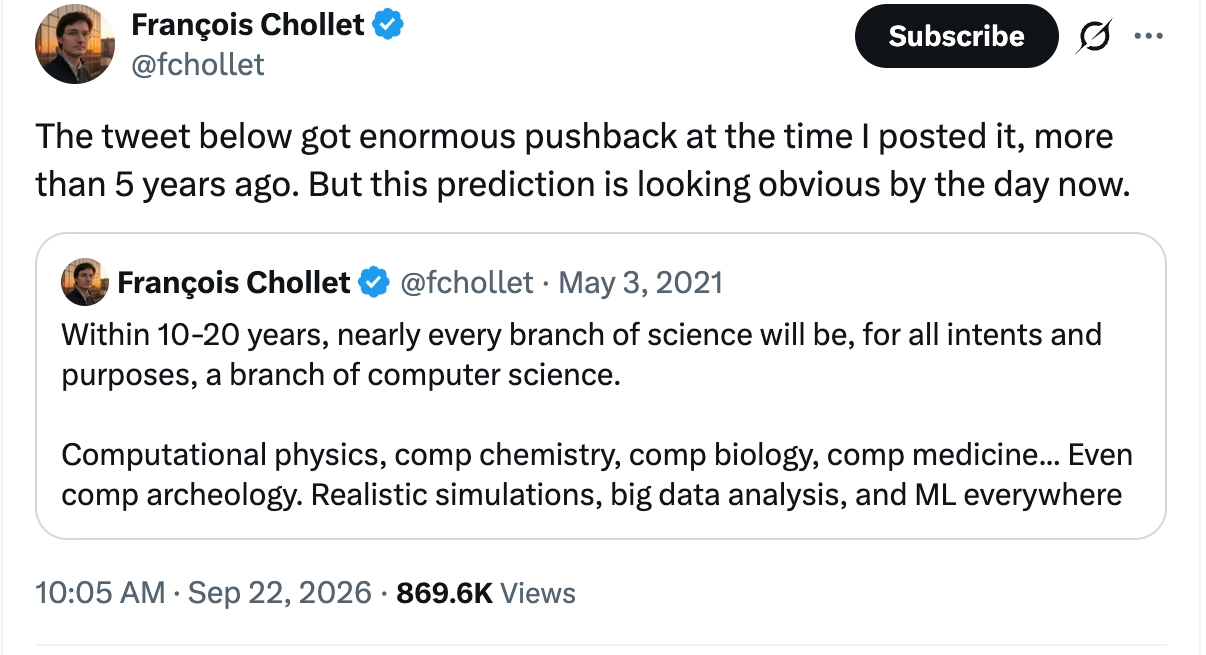
François Chollet predicted this in 2021: within ten to twenty years, nearly every branch of science would be “for all intents and purposes, a branch of computer science”. Anthropic’s interpretability team now recruits from astronomy, physics, mathematics and biology, because the model stopped being a program you debug and became a specimen you study.
Nathan Lambert describes an environments industry where labs buy ten to twenty environments at a time for millions of dollars, and micro1 offers companies $100k to $2M+ for the anonymised operational data those environments are built from. Professional judgment now has a price list.
Indeed’s Hiring Lab found AI-touched job titles more common outside tech than inside it in five of six markets, with 63% of US AI-titled postings now outside tech occupations. This isn’t a forecast.
Every field is starting with the junior work first
Geoffrey Hinton predicted in 2016 that AI would do a radiologist’s job within five years, and he’s since admitted he was wrong on the timing. He bet on the diagnosis. Medicine gave up the paperwork first. Ambient scribes are now the most widely deployed generative AI in healthcare, cutting EHR time by 13.4 minutes a day across five academic centres, and the clinician now checks a draft that can invent a diagnosis.
Law is not far behind, and it’s more brutal about it. Legal AI is best at exactly the first-pass review that paid for junior associates. Firms are moving from the pyramid to what iManage calls the diamond, with fewer entry roles and a thicker middle of specialists and technologists.
Labs have automated routine work for decades, but “humans were always pulling the strings. They were the ones developing the hypotheses and deciding which experiments were needed to test them. Now that paradigm is changing.”
Inside every field the sequencing looks similar - AI’s taking the operational work first and the decisions last. The cost of a wrong draft is cheap vs a wrong call. We’ve seen it in medicine and law, software handed over the code before the architecture; science is handing over the literature search and the experiments before the choice of what to test. Unfortunately the operational layer is where the juniors learn the job.
Whether that means fewer junior jobs is still open, and I’d rather say so than quote the half that suits me. Stanford finds employment for 22-25 year olds in the most AI-exposed occupations down about 11% since late 2022, while the least exposed grew about 10%. Ramp joined its card-spend records to workforce data across 21,000 firms and found entry-level headcount up 12% at heavy AI adopters. The skills data is pointing the other way. PwC finds the most exposed entry-level jobs are 7x more likely than the least exposed to demand traditionally senior skills. The New York Fed’s regional surveys describe AI’s effect so far as changing skill requirements rather than eliminating jobs.
Why the official numbers can’t see it yet?
Read the official statistics and it looks like none of this has happened and is in the future. Yale’s Budget Lab finds no link yet between AI use and employment in the August 2026 survey data. But part of that silence is because Federal job statistics are still counted in the 2018 Standard Occupational Classification, fixed before ChatGPT existed. It has no code for an AI engineer, a forward deployed engineer or an interpretability researcher, and the 2028 revision won’t be in use until reference year 2028. When Yale says the occupational mix isn’t changing, it’s reporting the mix of categories frozen in 2018.
MIT’s Project Iceberg gets underneath the codes by counting skills. The technology roles the headlines cover account for 2.2% of US wage value, about $211 billion. Skills AI can already perform across administrative, financial and professional work account for 11.7%, about $1.2 trillion, and they’re spread across every state. Delaware and South Dakota score higher than California.
Even the direct measurements are struggling to keep up. METR has retired its 2025 finding that AI made experienced developers slower, and its late-2025 follow-up estimates an 18% speedup for the returning developers. The study itself is being redesigned because too few developers will work without AI to fill a control group.
What to do before the data catches up
Every role in the taxonomy below asks for judgment. The first rung now asks for the judgment you used to earn by climbing. So who’s going to be qualified to write the evals in 2035? The people who start building that judgment now, on purpose, because the work that used to build it by accident is going first.
Narayanan, for all his caution about timing, agrees on the direction. He expects human effort to shift “from building towards evaluation and monitoring”, with domain knowledge and normative judgment gaining in importance.
If you’re a student
- Learn to check the machine in your field. In medicine that’s validating a generated note; in law, sampling a model’s document review; in software, writing the eval. Get reps at it before anyone pays you to.
- Pair your subject with the computational layer inside it. Anthropic’s interpretability team hires astronomers, physicists, mathematicians and biologists. Be the person in your field who can test what the model does.
- Practise judgment where mistakes are cheap. Law firms are training new associates on simulated cases so they can fail safely. Find the equivalent in your field: projects where you make the call and someone senior checks it.
If you’re already working
- Move up a layer before yours moves. List the operational parts of your job, because that’s what goes first. Put your hours into the parts where you specify, evaluate and decide.
- Read job specs, not job titles. The official categories are frozen until 2028. Postings show the new shape now, and 63% of US AI-titled postings are already outside tech.
- If you manage people, rebuild the rung. Your juniors learned on the work you’re automating. Give them the evals to write and the AI output to review, with a senior checking their calls.
The official numbers will catch up in 2028. Don’t wait for them.
Try it yourself
The full taxonomy
Find your role below. Thirty-one role morphs across six disciplines, scanned off career pages, research-team pages and industry reporting between March and September 2026. Four rows rest on a named study, 10 on job postings, 13 on industry reporting, one on a research team page, one on a vendor’s own claim, and two on nothing but my argument.